

Raising Orthodox Christians
CHAPTER 1
There’s Only One True North
You know the moment. You’re standing at the kitchen counter at 7:14 a.m., lunches half-packed, coffee getting cold, one kid crying because his sister looked at him wrong, another one missing a shoe. (It’s always one shoe, right? Never both. Why is that?) And somewhere in the chaos, while you’re praying nobody notices the lunch is only crackers and string cheese, you think: Am I doing any of this right?
We’ve been there. More times than we can count.
When our children were small, we spent many of our mornings in some version of that scene. Running late, completely overwhelmed, hoping whatever we were doing qualified as parenting. We loved our children fiercely. We loved Christ. We loved the Church. But if you’d asked us to explain how all those loves connected into a clear parenting vision, an actual destination we were aiming for, we would’ve stared at you blankly while searching for the missing shoe.
Everything changed when we realized this: Every family is climbing toward something. Whether they realize it or not.
The question isn’t whether you’re on a journey. You are. The question is whether you’ve chosen your summit or whether you’re climbing blind, waiting to see where you end up.
THE SUMMIT THAT CHANGES EVERYTHING
Mountains have always held great importance in the life of the Orthodox Church, appearing often in Holy Scripture and in the writings of the Church Fathers.
On Mount Sinai, the Lord appeared to Moses in the Burning Bush and handed him the Ten Commandments. On the Mount of Temptation, Christ fasted for forty days and met the devil face to face. On Mount Tabor, Peter, James, and John watched Jesus transfigured in blinding, dazzling light as He stood alongside Moses and Elijah. The mountaintop is important. And what happens on the top of the mountain? Even more important.
Of all those examples, Mount Tabor gets us every time. The Feast of the Transfiguration is the Church’s way of showing us our highest calling, our ultimate summit: transformation. We are meant to be changed. Made new. Made like Christ.
Orthodox Tradition has a word for this. Theosis.
Theosis means becoming like God. Not divine in some abstract, impossible sense, but being called—all of us, including our kids—to take on the character, the virtues, the sacrificial love of Christ Himself. That He would live in us and through us, more and more, until we look less like the world and more like Him. The pursuit of becoming like Him is the work of a lifetime, and there’s no shortcut around it.
That’s the summit: Christlikeness. It’s the only summit that matters.
If you’re reading this thinking, My kid threw a waffle at his brother’s face this morning so theosis feels like a bit of a stretch, don’t worry. We hear you. We really do. When your children are screaming at each other or melting down in the grocery store, it can feel impossible to imagine them one day possessing the humility, the patience, the sacrificial love we see in Christ.
But that’s the calling: for you and your family to choose a life aimed at becoming more like Him. One Grace-filled day at a time.
THE PARADOX YOU NEED TO HEAR
Chasing perfection and keeping score often tripped us up. (And if you’re reading a book about parenting in the twenty-first century, there’s a decent chance they trip you up too.)
The goal for every Christian parent is Christlikeness. But here’s the catch: None of us will achieve it in this lifetime.
The daily, messy, two-steps-forward-one-step-back struggle to help ourselves and our children grow closer to Christ—that is the path to salvation. It’s not about arriving or performing. It’s certainly not about getting it right every time. Instead, this path involves struggling. It involves turning back when we wander off, saying, “Forgive me, Lord. I’ll try again.”
Paul loves to visit Mount Athos, the Holy Mountain in Greece where monks across many monasteries live in dedicated prayer to God. There’s something about standing on that peninsula with nothing but stone and wind and centuries of prayer in every direction that resets a person entirely. Paul heard this story there: Two men were on a path. One had climbed far up, making huge spiritual progress, getting quite close to the top. The other was near the bottom and kept falling constantly. He hadn’t made much progress at all. But every time he fell, he would get back up and whisper, “Forgive me, Lord. I will try again.”
Both men died before reaching the summit.
An abbot on Mount Athos asked his monks, “Will the Lord not take both of them Home? The one who climbed far and the one who struggled mightily but kept falling and getting back up?”
The abbot’s answer: “Of course He will.”
That’s Orthodoxy. It’s not about how high you’ve climbed. It’s about whether you’re facing the right direction and whether you keep choosing to get back on the path when you stumble off it. This is why the Church teaches the importance of repentance and why we confess. The Church always offers us a way back if we choose to take it.
St. Porphyrios, one of the most beloved saints of our time, says this: “God is the summit of desire. No other joy, no other beauty, nothing else can rival Him.”2
Nothing.
And Christ Himself tells us where to aim: “But seek first the kingdom of God and His righteousness, and all these things shall be added to you” (Matt. 6:33).
If we raise children who pursue humility, sacrifice, patience, kindness, courage, hard work, and love—the qualities we see in Jesus—every other decision they face will become easier. Because they’ll know where they’re going.
Paul discovered this from an unexpected angle. During his years as president of a large investment bank, he found that the single best predictor of a great hire wasn’t their résumé. It was their character. A person of genuine virtue was far more prepared to succeed than someone with the most impressive financial credentials. Turns out God’s design works even on Wall Street. (Who knew? Well, God knew. But we were slow learners.)
AN ANCIENT MAP FOR A MODERN CLIMB
Do you know what summit you’re climbing toward as a family?
We didn’t know. Not for a long time.
We were getting the kids to school in clean clothes. Driving to the next activity. Making sure everyone ate something resembling dinner. We were doing what was right in front of us, and that’s not nothing.
But if someone had asked us to name our ultimate destination as parents, we might’ve said something about family and Church. Though we might also have said something about good grades, good colleges, good character, and good jobs. All fine goals. But none of them are the summit.
What we didn’t realize was how dramatically our focus on those everyday goals would shift once we understood our ultimate destination.
This summit analogy isn’t something we came up with ourselves. What we love about this analogy is that it clearly depicts what we were trying to do—live the life of the Church. Because of that, it’s a wonderful parenting tool. The analogy comes from Holy Scripture and the Church Fathers. St. Symeon the New Theologian, a saint born in 949, used this analogy with the monks in his monastery. He describes the summit as the Kingdom of Heaven, or in other words, salvation. And he describes the road that would bring them there as the path of holiness:
Now join me in examining carefully the force of these words. With me depict in your mind a road well worn by the feet of those who have made a good start on it. On either side imagine mountains, forests, precipices, peaks, and ravines, as well as plains, gardens, and places that are pleasant and shaded and very beautiful, with all kinds of fruit, with great numbers of wild beasts, of bandits and gangs of murderers scattered in various places. Under these conditions none of these things will be able to entice us or disturb our sense or cause us harm so long as we follow the saints who have gone before us and by the same road that they walked. For when we go on the path of the commandments of our Lord and God (Ps. 119:1ff, 12) let us go on it without turning aside in the midst of all the perils I have mentioned. Then none of those bandits, none of those wild beasts will openly and shamelessly assault us or venture to come near us, especially if we follow a guide and travel in company with good companions on the way. 3
Those same dangers still call out to us today, but you may not recognize them right away.
Cindy remembers the season when we looked at the family calendar and realized if we said yes to the ski team (we do live in Minnesota, after all), we wouldn’t be in Liturgy for the entire winter season, which is a long time here. None of the coaches or other parents had even mentioned it. That was the moment it hit us: The path was shifting underneath our feet and we hadn’t noticed. What we realized was that no one else was going to be responsible for keeping Sundays sacred. That was on us.
This is one of many subtle shifts. The career ambition that slowly, without anyone noticing, becomes the family’s actual god. The screen time that fills the silence where prayer or conversation used to be. The social pressure to give your kids everything the neighbors’ kids have because what if they fall behind?
None of these are evil. But any of them, pursued as the ultimate goal, becomes a different summit on a different mountain. And the paths that lead there don’t lead Home.
The world offers more than random distractions, though. It tells a consistent story about what makes a good life: achievement, comfort, status, security. It’s a compelling one, and it’s everywhere. In the school system, in the culture, in the air your kids breathe every single day.
The Church, however, offers a different story. A truer one! A story where the summit isn’t a corner office or a college acceptance letter but union with the living God Who made your children and loves them more than you do.
CHRIST AT THE SUMMIT: A PICTURE WORTH STUDYING
Kids respond to what they can see. So do we.
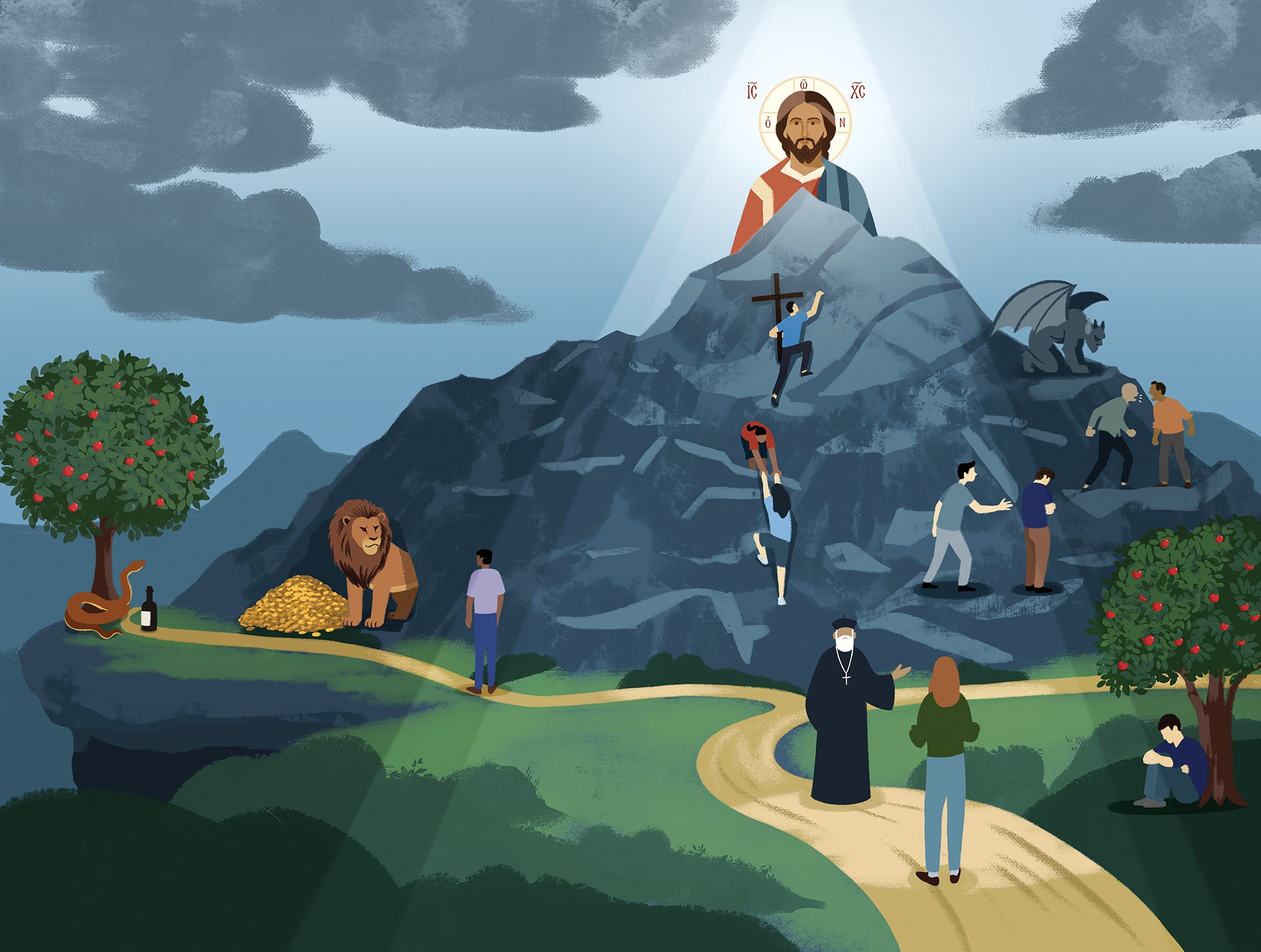
Study the image below. What do you see?
At the summit: Christ. Salvation. The Kingdom of Heaven. His Divine Energies pour down onto the path like light. When we walk this road, we walk in that Grace. When we step off, we step out of it. Near the bottom, notice the priest. We all need a spiritual father or mother, someone who has climbed this path before us and can help us navigate. Our kids need to know you can’t make this journey alone.
The figure in this image that always gets Paul is the man who is carrying a cross on his back, higher up on the path. Someone who has made real progress. Full of humility, sacrifice, and love. A role model. Someone worth following. Paul says it reminds him of a monk he once met on Mount Athos who lives a simple life. A life many might call a boring routine. But he was full of peace, gentleness, joy, and warmth—more than Paul had ever encountered. That’s what progress looks like on this path. Not more stuff. More Christ.
See the person reaching down to pull someone up a cliff? That could be a spouse. Or a friend. Maybe it’s someone from your parish. Sometimes we’re the one reaching down. Sometimes we’re the one being pulled up. Either way, we climb together.
Now look to the left. A path veering off toward temporary pleasure: drinking, drugs, sexual sin, people-pleasing, materialism. The lion on that path is real danger. And notice the man whose head has drifted outside the light while his body is still on the path. His thoughts went first. That’s how it always works. Temptation starts in the mind before it becomes action. Teaching our kids to guard their hearts and their eyes against harmful content, against the endless scroll, against anything that wounds their souls, is part of the daily work of this climb.
Toward the lower right, someone is calling a friend back to the path. This might be the most moving part of the whole image. We can teach our children to love their friends well and still refuse to follow them into danger.
“I’m not going down that road with you. But I’ll be right here when you come back.”
That’s godly friendship.
And then the right side of the path shows the passions of dejection, anger, pride. The figure under the tree, head down, hopeless. The two people fighting, passion out of control. That dark figure looming above them is the enemy, and he is working hard to pull them off this road.
Share this image with your kids. Talk about it. Let them point to the parts that feel familiar. You might be surprised by what they see.
OUR SUMMIT JOURNEY: THE HONEST VERSION
For Orthodox Christians, our summit is union with Christ. Theosis. Eternal life in the Kingdom of Heaven with the Lord Who loved us first.
We technically knew that, but we hadn’t used that knowledge to guide all the decisions we made as a family. This was a massive shift for us. It didn’t happen in a weekend retreat. It happened slowly, over years, through a thousand small recalibrations, most of them prompted by one of us grabbing the other and saying: “Hey. What summit are we climbing toward right now? Because I think we drifted.”
It happened the night Cindy looked at the calendar and realized we had booked activities that conflicted with Wednesday evening Family Nights, and nobody had blinked. It happened when Paul came home from speaking at a parish and said, “I think we need to rethink some things.” It happened in a hundred unremarkable moments that, together, changed everything.
Sometimes Cindy would notice first, and other times Paul was the one offering the reminder. Each of us leaned on the other because it was too easy to get off the path.
The important truth we want to plant in your heart before we go any further is this: You are taking your children with you.
Wherever you climb, they climb. Whatever path you walk, they walk. Young children on a hike rarely wander away from their parents. They instinctively know safety is wherever mom and dad are. Your kids are doing the same right now, spiritually. They’re following you. Whether you’ve chosen your summit deliberately or stumbled onto a path without thinking about it, they’re right behind you.
That can feel heavy. But it’s not too late. If you reorient today, even after years of wandering, your children will notice the change. They’ll feel the peace. They’ll sense something shifted. And more often than not, they’ll follow.
St. Symeon warned his monks that many other paths would call to them. Easier hikes, more pleasurable routes, shortcuts that promise the same reward without the struggle. But those paths lead to danger. And some lead to destruction.
Everything in this book rests on one foundation: We must be climbing in the right direction if we want our children to be.
CONFIDENCE FOR THE CLIMB
If you’re reading this and feeling a knot in your stomach or realizing your family’s summit has been more about sports teams and transcripts than Christ—exhale.
You’re not disqualified by anything you’ve done or failed to do up to this point.
The path of holiness isn’t reserved for families who started perfectly. It’s for every family who is willing to turn around, face the summit, and start climbing. Even from where you are right now.
What the Church offers you is the confidence to take your kids on the most challenging but life-giving climb imaginable. There is no better path. There is no better summit. There is no better destination than salvation with our Lord and Savior Jesus Christ.
But the climb will not be easy. You’re going to need gear—really good gear. And a roadmap you can trust. That’s what this book is for.
Get ready to grab the plans. Fill the backpacks. Stock up on food and water. Find your companions and your guides. We’ll be right there with you.
Let’s climb!
Loved Chapter 1?
There's so much more ahead.
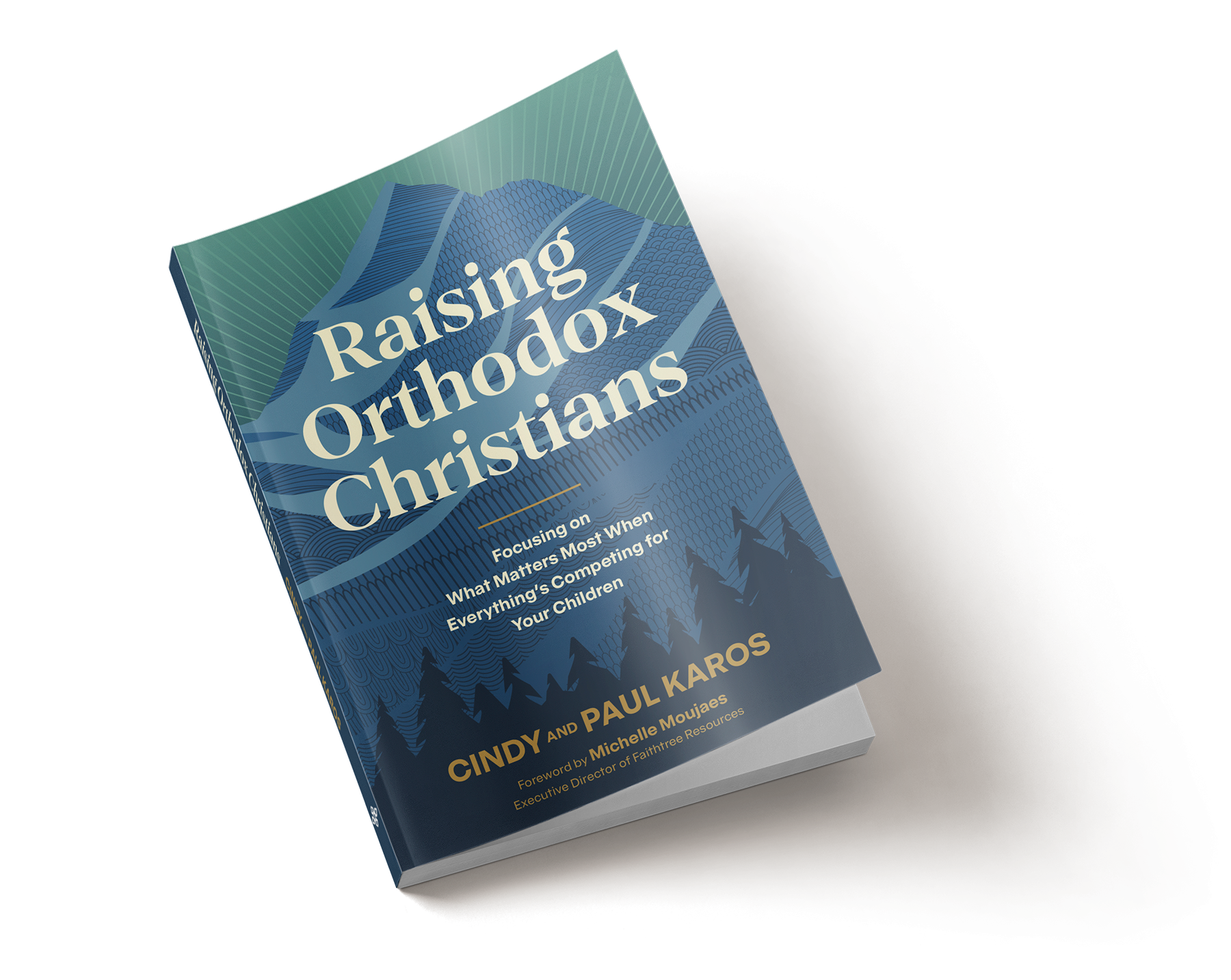
You've seen where the journey begins. The rest of Raising Orthodox Christians walks you through the everyday decisions around school, sports, friendships, phones, money and more, using the timeless wisdom of the Church to bring each one back to what matters most.
Preorder your copy today and keep your family pointed toward Christ, one everyday decision at a time.
Plus, when you preorder, you'll receive $250 in free bonus items.
NOTES
- St. Porphyrios, Wounded by Love: The Life and Wisdom of Saint Porphyrios, trans. John Raffan (Limni, Evia, Greece: Denise Harvey, 2018), 100.
- Symeon the New Theologian, The Discourses, trans. C. J. de Catanzaro (New York: Paulist Press, 1980), 136–37.